Data warehouses solved data fragmentation for reporting. The Intelligence Warehouse solves context fragmentation, driving 98% AI accuracy at 1/8th the cost.
SAN FRANCISCO, CA, UNITED STATES, February 24, 2026 /EINPresswire.com/ — Questt AI today announced the launch of the Intelligence Warehouse, a structured business-knowledge architecture designed to enable AI agents to operate reliably in enterprise production environments.
Two decades ago, enterprises faced a data fragmentation problem. Numbers lived in silos. Reports conflicted. Trust in outputs was low. The data warehouse solved this by creating a single, reliable layer for reporting on top of raw data.
Today, enterprises face a challenge one layer above data. AI agents can access systems but don’t understand how the business operates – the formulas, thresholds, or approval authority. The data exists; the logic does not. Enterprise AI struggles in production not because models lack capability, but because the rules were never formally structured.
The pattern is consistent:
• An agent connected to a data warehouse retrieves accurate numbers but doesn’t know the business rules attached to them.
• It recommends a 15% markdown when company policy allows 10%.
• It cannot explain its decision in policy-aligned terms.
The issue isn’t access to data. It’s the absence of structured decision logic.
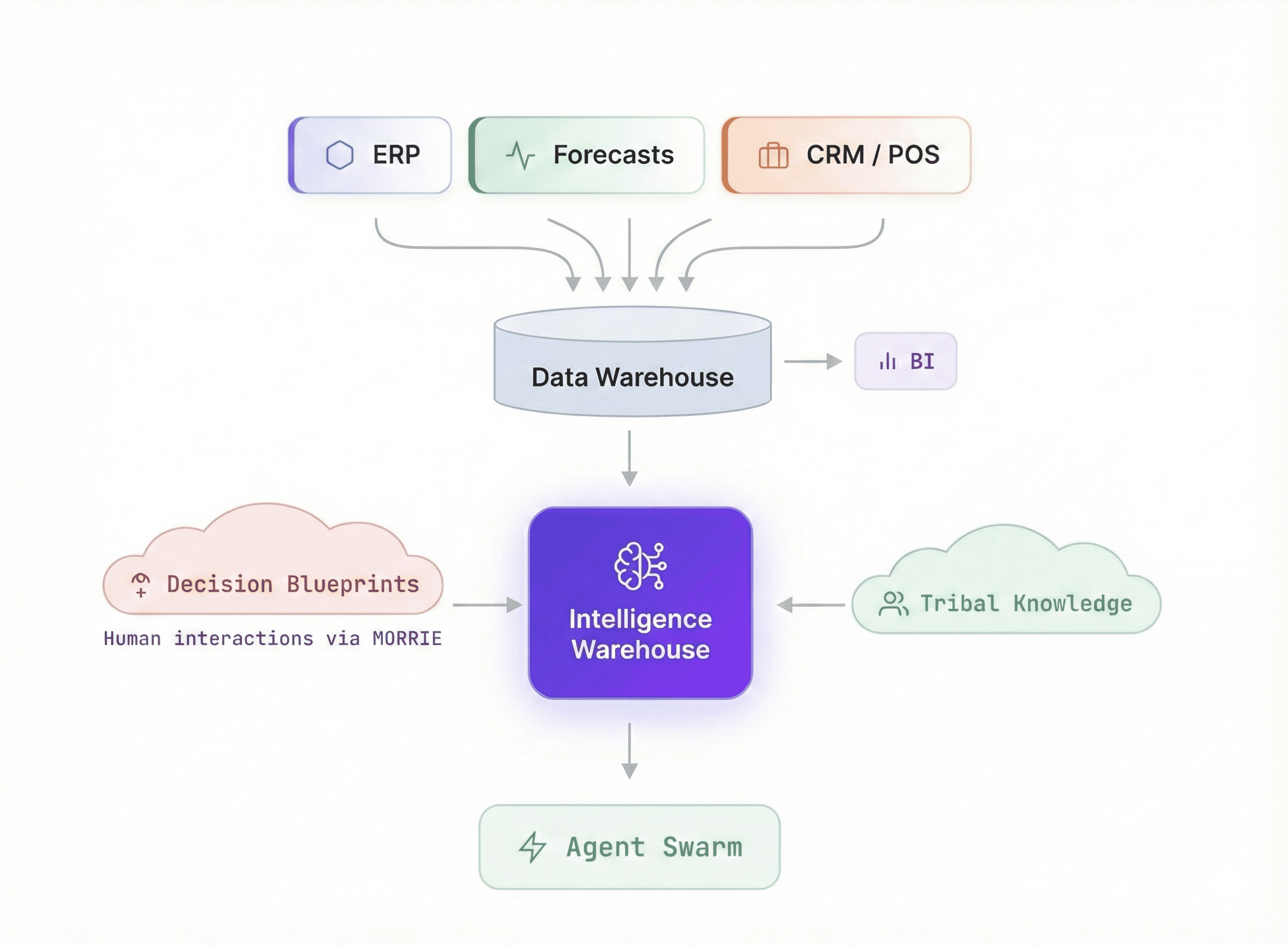
To address this gap, Questt AI developed the Intelligence Warehouse – a layer that encodes business logic in a form AI agents can reliably use.
It is built on three interconnected layers:
• L3 | Decision Rules: How the business acts. Trigger conditions, persona authority, and escalation paths.
• L2 | Metrics & Formulas: How the business measures itself. Explicit formulas and threshold bands.
• L1 | Business Ontology: What the business is. Product hierarchy and sales organization with real relationships.
No single layer is sufficient. Together, they allow an AI agent to move from a raw number to a governed decision.
In production deployments, organizations building an Intelligence Warehouse have achieved up to 98% decision accuracy, at roughly one-eighth the cost and time of conventional enterprise AI approaches.
Against existing methods, the difference is structural:
• Data warehouses retrieve numbers but don’t encode rules.
• BI tools compute metrics but don’t operationalize decisions.
• Prompt engineering doesn’t scale.
• Ontology-only approaches resolve entities but don’t tell the system how to act.
The Intelligence Warehouse connects retrieval, formulas, decision logic, authority, and auditability into a single usable layer.
The hardest part of building this layer is not technology. It is extracting decision logic that typically lives in people’s heads.
Questt’s proprietary tool, Morrie, captures decision blueprints through structured interviews. It extracts the exact rules, thresholds, and authority chains that define how a business operates. What traditionally takes months of documentation is compressed into under six weeks.
Questt AI builds decision intelligence for enterprises across FMCG, retail, financial services, and manufacturing. To learn more, visit intelligencewarehouse.com
Nidhi Prabhu
Reallearning Technologies Pvt Ltd
email us here
Legal Disclaimer:
EIN Presswire provides this news content “as is” without warranty of any kind. We do not accept any responsibility or liability
for the accuracy, content, images, videos, licenses, completeness, legality, or reliability of the information contained in this
article. If you have any complaints or copyright issues related to this article, kindly contact the author above.